Jin’s Capture in the Other World
Living with 7 vampiresJin’s Capture in the Other World is the decisive separation at the center of the mirror-world rescue arc. As pursuers close in, Jin pushes Y/N through the mirror to preserve her safety, but the passage breaks before he can follow. Alone on the other side, he hides in dog form, is discovered and threatened by the world’s inhabitants, and is eventually located in a stone enclosure that resembles a prison. The event transforms Jin from rescuer into captive and makes his later use of his own power to imprison the other seven figures a continuation of the same protective sacrifice.
Causes and Background
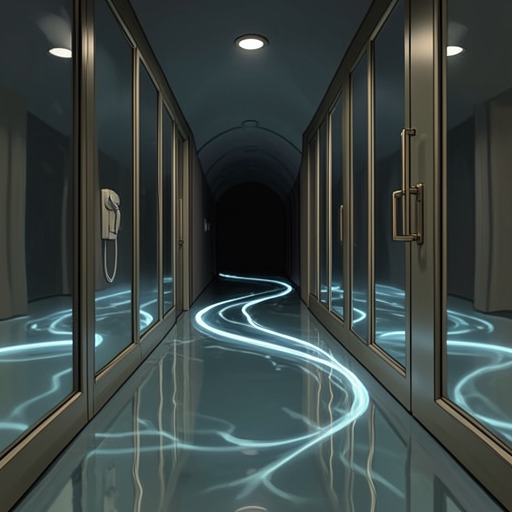
The capture grows out of the unstable relationship between the human world and the mirror passage. Y/N has already been abandoned in an unfamiliar place when her mother drives away, creating the first rupture between Y/N and ordinary human protection. Later, the discovery of a locked book, opened with a key and beginning with a dated entry, establishes written records as another route into concealed histories. The mirror then becomes a literal threshold: it can return a person to a room, but it can also pull someone inside and separate companions from one another.
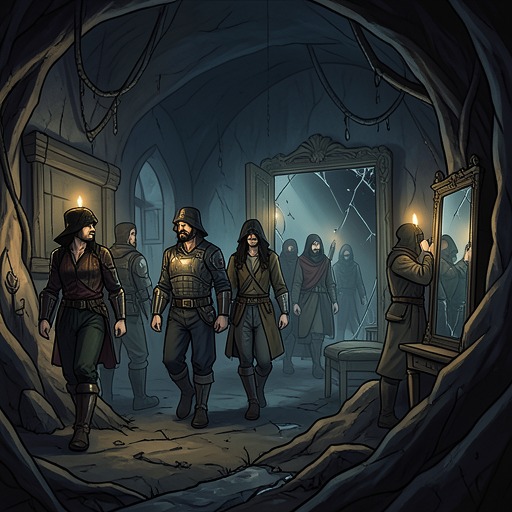
Jin and Y/N reach the mirror while unidentified pursuers are searching for them. Jin tells Y/N to enter and swim to the other side, and when the danger approaches he pushes her through the surface himself. The action is protective but also strategically irreversible. Y/N crosses; Jin remains exposed. The mirror is not simply a doorway in this sequence but a contested object whose opening determines who can escape, who must wait, and who can be cut off.
The Capture Beyond the Mirror
After Y/N has entered, a giant stone is thrown against the mirror and breaks it into pieces. Jin recognizes that Y/N is at least safe, then changes into his dog form and searches urgently for somewhere to hide. He finds a small cave and remains there in silence, but the quiet becomes a warning rather than protection. A hand suddenly grabs him by the neck fur, and his barking and growling reveal his presence.
The people who find him do not treat the animal form as harmless. One calls him a little monster, another identifies him as a dog, and one of them stares directly at him before threatening that he will pay for what happened. The scene therefore combines physical capture with hostile interpretation: Jin is vulnerable because his transformation conceals his identity, yet the captors still perceive him as an abnormal and punishable creature. His power to change form offers temporary concealment, not freedom.
The consequences become visible when Y/N and the others later investigate a small cave that looks more like a stone prison. A faint human outline appears inside, and the group realizes that the prisoner is Jin. When the stone pillars come down again, Jungkook helps Jimin and RM, while Jin slowly makes his way outside. Y/N immediately hugs him and apologizes. His release is thus framed not as a clean victory but as the physical restoration of a relationship interrupted by the mirror’s collapse and the captors’ violence.
Protection, Power, and Sacrifice
Jin’s conduct gives the event its ethical structure. He does not enter the mirror first and leave Y/N to chance; he orders her toward safety and physically pushes her through when pursuit becomes imminent. The broken mirror then makes the cost of that decision plain. His separation is not an accidental pause in the journey but the consequence of choosing Y/N’s survival over his own escape.
Jin later explains that he sacrificed his power to lock the other seven figures inside the mirror. The same pattern of self-expenditure governs both moments: power is used to shield others, and the protector becomes the person who bears the confinement. Because the others are badly wounded, he also uses what remains of his power to make them forget that the other people ever existed. His actions contain the threat, but they do so through enforced absence and memory loss rather than through a simple defeat.
Aftermath and Memory
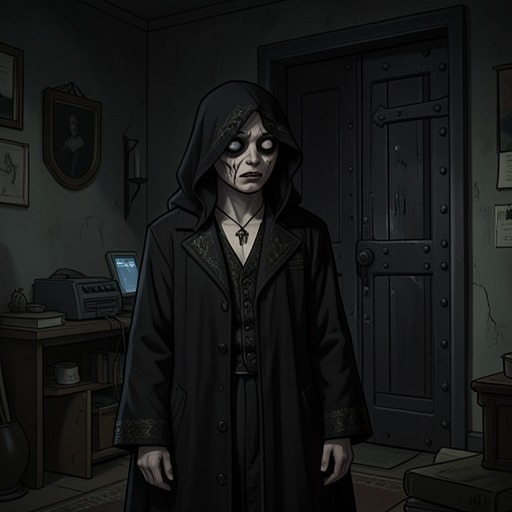
The rescue does not restore an uncomplicated reality. Jin’s imprisonment is followed by repeated disturbances involving mirrors, altered spaces, and uncertain returns. Y/N briefly reappears in her room after the mirror disappears, only to find V beside her, demonstrating how quickly a threshold experience can be converted into an apparently ordinary scene. Later, the room turns white again and returns Y/N to a place with four mirrors, suggesting that the passage remains active even when its visible form changes.
Memory becomes the principal aftermath of the capture and the larger supernatural conflict. Assiah eventually states that she erased Y/N’s memory, and later asks the group to stand together before making them slowly disappear. Jin’s earlier decision to erase knowledge of the other inhabitants therefore anticipates a broader regime of controlled remembering. The story repeatedly makes safety depend on forgetting: people are removed from ordinary knowledge, witnesses lose access to what happened, and the characters must recover meaning through objects, spaces, and partial recollections.
Narrative Significance
Jin’s Capture in the Other World gives the mirror-world plot its clearest value reversal. A passage expected to provide escape becomes a trap; Jin’s act of rescue produces his own exposure; animal transformation provides concealment but ends in discovery; and reunion arrives only after imprisonment has revealed the price of protection. The event also establishes that the mirror’s danger is material rather than merely symbolic: it can be entered, broken, crossed, and used as a prison.
The event’s lasting importance lies in the connection between bodily captivity and narrative captivity. Jin is held in stone, while the truth of the encounter is later held back by supernatural power and memory erasure. His eventual emergence and embrace with Y/N preserve the personal bond that the mirror tried to sever, but the surrounding changes show that rescue does not end the threat. Jin’s capture remains the moment when protection, confinement, sacrifice, and the politics of memory become inseparable.